Friday, January 21, 2011

Designing today!

Materials:
  • two tennis ball cans
  • scissors
  • 18 inch piece of tape
This isn't much materials to start with, but I guess we'll manage.

So Adiar, had a pretty awesome idea!
He says he has a "background" with cannons...... I don't think I even want to know.
Then he corrected himself after I told him that I would post that on the blog, (which I did anyway) and he said that this was the same concept as Nerf Guns.
I wouldn't know but the idea sounded great.
We're currently improvising Adiar's idea.

So, the most important part of the project is the distance in which they shoot. (NOT the name, Audrey!)
To have the farthest distance, it must have a low degree of elevation.
It also can't be too low, since we don't want it to skid on the ground and die out.
I wish we had more time to plan but we only have one day to plan beforehand. I hope we'll have enough time tomorrow.

Audrey: "Everyone better come to school tomorrow!"
Me: "Hey, is anyone going to CPR?"
Adiar: "What's CPR?"

..... Getting worried about the group

What I'm worried about it if the cannon will stay in place. What we're trying to do makes it unstable, and may not stand firmly and that'll change the trajectory in which it flies. We'll figure it out tomorrow!


__________________________________________________________________________________


Today, we needed to design.

This, is our design. Good thing we have an artist in our group, it looks really nice.

https://docs.google.com/document/d/1czG91H21cm5dQYcOGA3fiHShfidsntf1boWwAFGr7tM/edit?authkey=CLLqv84G&hl=en#

(sorry I had to link it, the pictures don't upload on this blog)
and this is the actual product.

https://docs.google.com/document/d/1h3MZwt0rloY36zja8GqGN9ZBPrfM6y0Tzokd5WyX32s/edit?hl=en&authkey=CInu4ocP

It's really cluttered, I don't know whose it was, but it makes the project look kindof bad haha (:

The actual product looks so much better than the picture :D

Its angle is exactly 45 degrees, which was the best angle according to our research.

We had several ideas, but this seemed to be the best. The part about it that made it the winning design was probably the lid. In our idea, we're including what used to be a tennis ball can lid which serves to create more pressure. According to the kinetic theory, the gas molecules are constantly in motion. It also states that the molecules only exerts force when it collides with another molecule, or a surface. We expect that creating a smaller chamber for the gas will increase the collision, which will result with the increase of force exerted.

https://docs0.google.com/document/d/1Z4GN2vFKzscI3GfNlzszoRb1n_EfiU575HEgWqkZ9lY/edit?hl=en#

Procedures

  1. Obtain Materials listed
  2. Cut about 5cm off of the bottom of one of the tennis ball cans and tape it at the bottom of the other can. The barrel needs to be at a 45 degree angle, so be sure to measure before taping.
  3. Mark one side of the already-cut can at 8cm, and the opposite side 16cm.
  4. Mark a line with the marker to connect these two dots.
  5. Make sure that this line is also 45 degrees, so that it'll be accurate
  6. Tape the base to the bottom of the barrel.
  7. Now, get the two lids of the tennis ball cans and cut off the rim.
  8. Then, cut the lids so that it'll fit perfectly in the barrel (The lids must be EXACTLY the same)
  9. Now, make several holes in the lids (preferably with a hole puncher) and try your best to make it even so that the gas will escape evenly from the holes. (we made about 8 arond the lid 1 in the center)
  10. Tape the two lids together.
  11. Insert and set the lid about halfway in the barrel. Make it air tight so that we can result with its maximum pressure.

Thursday, January 13, 2011

History of Cannons : Design

pre-1800s:


1300's -  Hand cannon :

  • Hand cannon was the first handgun ever invented. It was invented in China and was also used in Egypt.  It was used in battles, and although it doesn't look like it it proved to be very effective and could kill armored soldiers.  The cannon was effective from 50 meters to 300 meters. The closer the opponent was, the more effective it proved to be.

                                       
Manufacture:
  • China
Design:
  • The barrel was shorter than the firearms created afterwards
  • Made from wrought iron or bronze
  • weights varied; 1.5kg ~ 15kg
  • attached to wooden stock (easier to use)
  • Designed so that one person can hold the cannon firmly while another ignites the cannon or have the cannon propped against something and the gunner can ignite the cannon by himself.
Battles: Battle of Ain Jalut- battle between the Egyptians and Mongols

Ammunition Types: Varied; some used pebbles and others used balls of stone, arrows, or iron
(from American Legion's Burnpit)

1700s- Falconet:
  • The falconet was developed during the Middle Ages and were mainly used during the American Revolution.

Manufacture: Mostly used in American Revolution; oversized matchlock musket

Design:
  • barrel = 4ft long
  • caliber = 2in
  • weighed 500lbs
  • light for a cannon
  • Used Black Powder
Battle: American Revolution

Ammunition Type: grapeshot/ 1lb round shot


(wikipedia)
1800 -1900s:

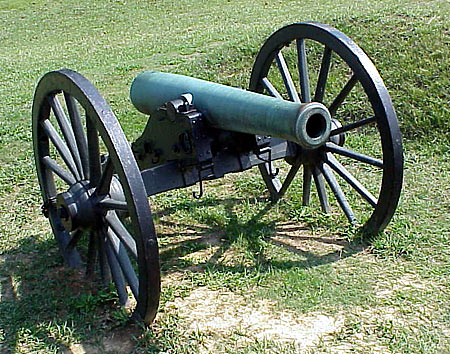
1857~ 1863- Smooth bore 12-pounder Napoleon Gun

  • This "Gun", or cannon, was used from the years 1857 to 1863. It was a common weapon used during the Civil War. Its maximum shooting range is up to 1,619 yards. Its name comes from the French Emperor Louis Napoleon III. The north and the south both used this cannon, but they manufactured it differently.
Manufacture: France

Design:
  • made with bronze(confederacy)
  • The bronze made the cannons stronger and safer than the ones made of iron (confederacy)
  • had a swell at the muzzle (Union)
  • made with iron (Union)

Battle: Civil War

Ammunition Type: 12-pound round cannonball


(from CivilWarTalk.com)

1900s- "Dora" (Heavy Gustav) Railroad Cannon

Manufacture: Germany

Design:
  • Width : 7m
  • Height : 11.6m
  • Weight : 1,350 tons
  • Barrel Length: 32.48m
  • Very useful because it was mobile and powerful
Battle: World War II

Ammunition Type: 7.1 ton armor capped projectile/ 4.8 ton high explosive projectile


1900s to Today:

1941- British Howitzers

  • This cannon was used in the beginning of World War I. At first it had a very limited shooting range, but when the war neared the end the cannon was able to fire 900kg shells over 18km. Useful to hide behind because it was massive.
Manufacture: Great Britain

Design:
  • long barreled field gun
  • short barrel
  • aimed high
Battle: World War I

Ammunition Type: heavy shells


81 mm M1 Mortar
  • Sometimes called "infantry artillery" or "hip pocket artillery" and were capable of laying down heavy barrages. They were used by the marine during the World War II.

Manufacture:  U.S.

Design:
  • A portable muzzleloading cannon
  • It shot with high trajectory (40-80 degrees)
  • 136lbs
  • shoots from 100 to 3,290 yards
Battle: World War II

Ammunition Types: shells

Thursday, January 6, 2011

Testingtestingtesting...

Hello, this is a test just to see if I can actually post this on here, since the last time it deleted EVERYTHING.
I am going to change the background, since the bird was the only thing I wanted and on the actual blog, you can only see the bird's butt. Very weird. Anywayy, BYEE :D